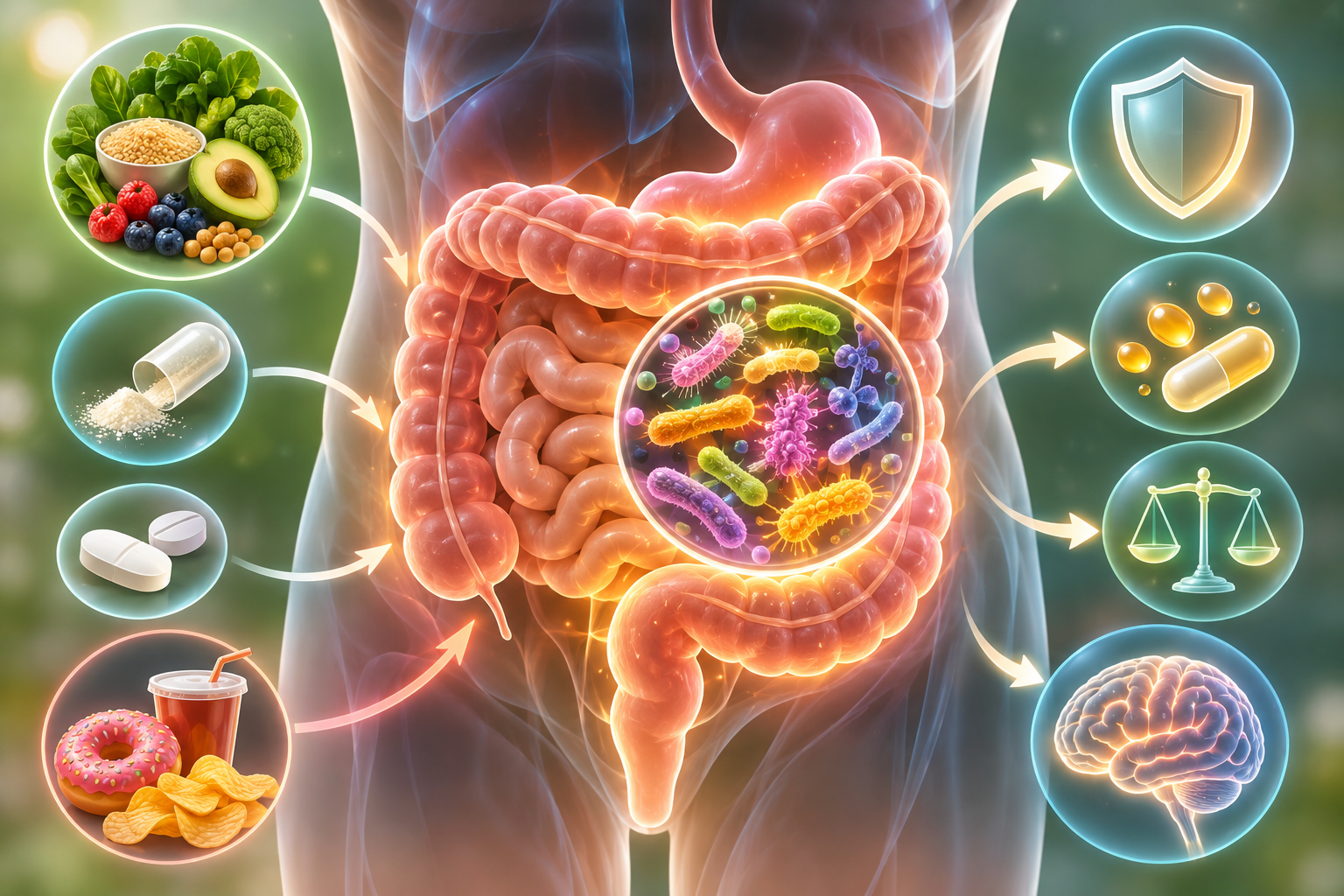
Part I. The Gut Microbiota, Immunity and Nutrient Absorption
We carefully choose our food, try to maintain a healthy diet, and take vitamins, minerals and nutritional supplements. Yet why is it that, despite all this attention to our health, our bodies sometimes fail to respond with the improvements we expect?
Why do fatigue, low energy, digestive disturbances or deficiencies in certain nutrients persist? And why can two people following similar diets feel completely different?
Perhaps the answer lies not only in what we consume, but also in how effectively our bodies can digest, absorb and utilise the nutrients we provide.
This is where the gut plays a particularly important role — a remarkably complex biological system whose significance extends far beyond the simple digestion of food.
“What matters is not only what we take, but also what our bodies are capable of absorbing.”
1. The Gut Microbiota — An Invisible Ecosystem Within Us
Our intestines are home to trillions of microorganisms, including bacteria, archaea, viruses, fungi and other microscopic forms of life.
Together, they form the gut microbiota — a living, dynamic ecosystem that develops alongside us and continuously interacts with our bodies.
*What are archaea?
Archaea are single-celled microorganisms that differ from bacteria and naturally inhabit the human gut. Some produce methane during fermentation, contributing to intestinal microbial activity and potentially influencing bowel movements.
What does the microbiota actually do?
Intestinal microorganisms participate in numerous physiological processes, including:
Breaking down dietary components that the human body cannot fully digest on its own.
Producing short-chain fatty acids and other biologically active compounds.
Supporting the protective functions of the intestinal lining.
Developing and regulating immune responses.
Participating in the metabolism of bile acids and certain nutrients.
Facilitating communication between the gut, nervous system and endocrine system.
The composition of the microbiota is unique to each individual. It is influenced by diet, age, lifestyle, environment, previous illnesses and medications.
Importantly, a healthy microbiota does not necessarily mean having the greatest possible diversity of bacteria.
What matters most is its functional resilience, adaptability and ability to maintain a balanced relationship with the human body.
2. The Gut and the Immune System: Why Are They So Closely Connected?
The gut is one of the body's most important sites of immune interaction with the external environment.
Every day, dietary proteins, fats, carbohydrates, microorganisms and various chemical compounds pass through the digestive tract.
The immune system must recognise potentially harmful substances while maintaining tolerance towards harmless food components and the microorganisms that naturally inhabit the gut.
A substantial proportion of the body's immune cells are associated with the gut and its mucosal surfaces.
Specialised immune structures are located here, protective antibodies — including secretory immunoglobulin A (IgA) — are produced, and local immune defence mechanisms are established.
The gut microbiota contributes to the development and regulation of these processes.
Crucially, the immune system must not only respond to threats but also know when to limit inflammatory reactions.
Disruptions in the relationship between the microbiota and the immune system are being investigated in connection with inflammatory bowel diseases, allergies and certain autoimmune conditions.
However, it would be incorrect to suggest that every allergy or autoimmune disease develops solely because of an imbalanced microbiota. These conditions arise through a complex combination of genetic, immunological and environmental factors.
3. The Intestinal Barrier — Our Internal Protective Boundary
The intestinal lining performs two essential functions: it enables nutrient absorption while restricting the passage of potentially harmful microorganisms and compounds.
This protective system consists of several interconnected elements:
A layer of mucus covering the intestinal surface.
Intestinal epithelial cells.
Tight junctions between neighbouring cells.
Immune cells and protective molecules.
The microbiota and substances produced through its activity.
In certain inflammatory conditions, infections and injuries affecting the intestinal lining, intestinal permeability may increase.
This is a genuine physiological phenomenon that is actively studied in modern medicine.
However, the popular term Leaky Gut is frequently used to explain almost every possible health concern, from persistent fatigue to chronic disease.
Such oversimplification is misleading.
Increased intestinal permeability may accompany certain medical conditions, but it is not, in itself, a universal diagnosis or proof of the underlying cause of every symptom.
Understanding intestinal health requires consideration of the overall clinical picture rather than reliance on a single measurement.
4. Why Do We Take Vitamins but Not Always See Results?
Many people evaluate nutritional supplements primarily by their ingredients and dosages.
How many milligrams of magnesium? Which form of iron? How much vitamin D or B12 does each capsule contain?
Yet there is a fundamental difference between the amount of a substance we consume and the amount our body can actually absorb and utilise.
Between nutrient intake and its physiological action lies a sequence of processes:
Intake → Digestion → Release → Absorption → Transport → Cellular Utilisation
Limitations may arise at any stage.
The Stomach and Gastric Acidity
Stomach acid is essential for certain normal digestive processes.
For example, vitamin B12 obtained from food is initially bound to proteins. Gastric acid and digestive enzymes are required to release it.
Long-term use of medications that suppress stomach acid, particularly proton pump inhibitors (PPIs), may impair the absorption of food-bound vitamin B12 in some individuals.
However, vitamin B12 in most supplements is already present in a free form and does not require the same initial release process.
The Pancreas and Digestive Enzymes
The pancreas produces enzymes required to digest proteins, fats and carbohydrates.
In exocrine pancreatic insufficiency, food may not be adequately digested, potentially leading to nutrient malabsorption.
Fat absorption is particularly vulnerable, along with the absorption of the fat-soluble vitamins A, D, E and K.
Bile and Fat Absorption
Bile acids help emulsify dietary fats and form structures necessary for their absorption in the small intestine.
Disruptions in bile delivery or bile acid metabolism may affect fat digestion and the availability of fat-soluble vitamins.
The Condition of the Small Intestinal Lining
Most nutrient absorption takes place in the small intestine.
When its lining is damaged, as may occur in untreated coeliac disease, the absorption of iron, folate and other nutrients can become impaired.
Consequently, a person may consume sufficient nutrients through their diet while still developing laboratory-confirmed deficiencies.
Medication Interactions
Certain medications can influence the metabolism or availability of specific vitamins and minerals.
For example, long-term metformin use is associated with an increased risk of reduced vitamin B12 levels.
This is not a reason to discontinue prescribed medication independently, but it highlights the importance of considering possible interactions when assessing nutritional status.
There is another important reason why supplements may fail to produce noticeable results: not every symptom is caused by a vitamin deficiency.
If the body does not require additional amounts of a particular nutrient, taking more of it will not necessarily improve wellbeing.
Fatigue, hair loss, muscle weakness and poor concentration can all have many different underlying causes.
Before increasing supplement dosages or introducing additional products, it is important to establish whether a deficiency actually exists, what is causing it and whether the chosen supplement can genuinely address the problem.
5. The Microbiota and Vitamins: Who Benefits Whom?
Certain intestinal microorganisms are capable of synthesising B vitamins and vitamin K.
However, it is important to distinguish between a microorganism's ability to produce a substance and the human body's ability to utilise it.
For example, vitamin B12 is absorbed primarily in the terminal section of the small intestine. A significant proportion of microbial vitamin synthesis occurs in the large intestine, meaning that this process cannot be considered a reliable source of vitamin B12 for humans.
The microbiota's role extends far beyond the direct production of vitamins.
Intestinal microorganisms participate in the transformation of certain dietary compounds, bile acid metabolism and the production of metabolites that interact with intestinal cells.
Nevertheless, the absorption of most vitamins and minerals relies on the physiological mechanisms of the small intestine rather than directly on bacteria.
The microbiota is an important participant in metabolism, but it is not the only factor determining how effectively our bodies benefit from food and nutritional supplements.
6. What Are We Feeding Our Microbiota?
When discussing nutrition, we usually think about proteins, fats, carbohydrates, vitamins and calories.
But there is another important question: what do the microorganisms living in our intestines receive from our diet?
Certain dietary components are not broken down by human digestive enzymes. Instead, they reach the large intestine, where they become substrates for microbial fermentation.
Various types of dietary fibre are particularly important.
During fermentation, intestinal bacteria produce short-chain fatty acids.
Butyrate (butyric acid) — provides an important energy source for the cells lining the large intestine. It also contributes to the maintenance of the intestinal barrier and regulation of local immune processes.
Propionate (propionic acid) — participates in metabolic processes, including interactions with the liver and systems involved in metabolic regulation.
Acetate (acetic acid) — is produced in substantial amounts during microbial fermentation and can be utilised by various tissues throughout the body.
These compounds help explain why the benefits of dietary fibre extend beyond simply regulating bowel movements.
Prebiotics and Resistant Starch
Certain dietary components possess prebiotic properties: they are selectively utilised by microorganisms and provide a demonstrated health benefit.
Examples include inulin and particular fructooligosaccharides.
Resistant starch is a form of starch that escapes digestion in the small intestine and can undergo fermentation in the large intestine.
Sources may include legumes, some wholegrain foods, and starchy foods that have been cooked and subsequently cooled.
Polyphenols
Berries, green tea, cocoa, olives and many other plant-based foods contain polyphenols.
Some of these compounds are transformed by intestinal microorganisms, while the resulting metabolites may participate in physiological processes.
Dietary Diversity
Different microorganisms utilise different dietary substrates.
A varied diet containing a wide range of plant foods therefore helps supply the microbial community with a broad selection of nutrients.
In the United Kingdom, adults are advised to aim for approximately 30 g of dietary fibre per day.
However, fibre intake should be increased gradually. In people with irritable bowel syndrome (IBS), significant bloating or certain other digestive conditions, particular types of fibre may aggravate symptoms and require individual adjustment.
7. When Balance Is Disrupted: What Is Dysbiosis?
Changes in the composition and function of intestinal microbial communities are often described as dysbiosis.
This term is used to describe disrupted interactions between microorganisms and their relationship with the human body.
Such changes may be observed in certain diseases, following antibiotic treatment, after significant dietary changes and in response to other influencing factors.
However, dysbiosis does not imply that there is one ideal bacterial composition that everyone should strive to achieve.
The microbiota naturally differs between individuals, and these differences do not always indicate disease.
Therefore, detecting particular bacteria in a stool sample does not automatically mean that treatment is necessary.
Modern commercial microbiome tests can provide interesting information about microbial communities, but their clinical interpretation still has significant limitations.
8. When Should We Pay Closer Attention to Gut Health?
Digestive disturbances and nutrient malabsorption can present in different ways.
Particular attention should be given to the following symptoms:
Persistent changes in bowel habits, including chronic diarrhoea.
Frequent, painful abdominal bloating.
Greasy stools that are difficult to flush.
Unexplained weight loss.
Recurrent deficiencies in iron, vitamin B12 or other nutrients.
Significant weakness accompanied by laboratory-confirmed nutritional deficiencies.
An inadequate response to appropriately selected treatment for an established deficiency.
These symptoms are not specific indicators of microbiota imbalance.
They may be associated with a range of digestive disorders and warrant appropriate medical investigation.
It is especially important not to delay medical assessment if there is blood in the stool, unexplained weight loss or signs of significant anaemia.
9. Where Does Caring for Your Gut Begin?
Supporting intestinal health does not necessarily require complicated protocols, numerous supplements or the continuous use of probiotics.
The foundation lies in everyday habits:
Eating a varied diet with sufficient amounts of suitable dietary fibre.
Regularly including vegetables, berries, legumes and other plant foods, according to individual tolerance.
Maintaining adequate hydration.
Engaging in regular physical activity.
Getting sufficient, good-quality sleep.
Using medications responsibly, particularly antibiotics.
Identifying and appropriately investigating digestive disorders and confirmed nutritional deficiencies.
Fermented foods, such as natural yoghurt, kefir and fermented vegetables, can also form part of a varied diet when well tolerated.
However, not all fermented foods contain live microorganisms at the time of consumption, and not every fermented food qualifies as a scientifically established probiotic.
The key is to avoid searching for a single universal product or supplement that promises to restore the entire microbiota.
Gut health is supported not by one substance alone, but by the coordinated functioning of the digestive, immune and metabolic systems.
Conclusion: Health Begins with Understanding
We are accustomed to asking which vitamins, minerals or supplements we should take to maintain our health.
Yet it is equally important to understand how effectively our digestive system functions and whether our body can properly utilise the nutrients we consume.
The gut is far more than an organ responsible for food digestion. It is a place of continuous interaction between our diet, microbiota, immune system and metabolic processes.
The better we understand these relationships, the more informed and thoughtful our approach to health can become.
Sometimes, rather than adding another vitamin, it is more important to understand why the body is not receiving the expected benefit from what it is already being given.
Coming in Part II: What Influences Our Microbiota Every Day?
🪷 VITA MAGNA
Understand Your Body. Support It Wisely.
The Art of Wellbeing.