CARTILAGE DOESN’T LIKE STILLNESS
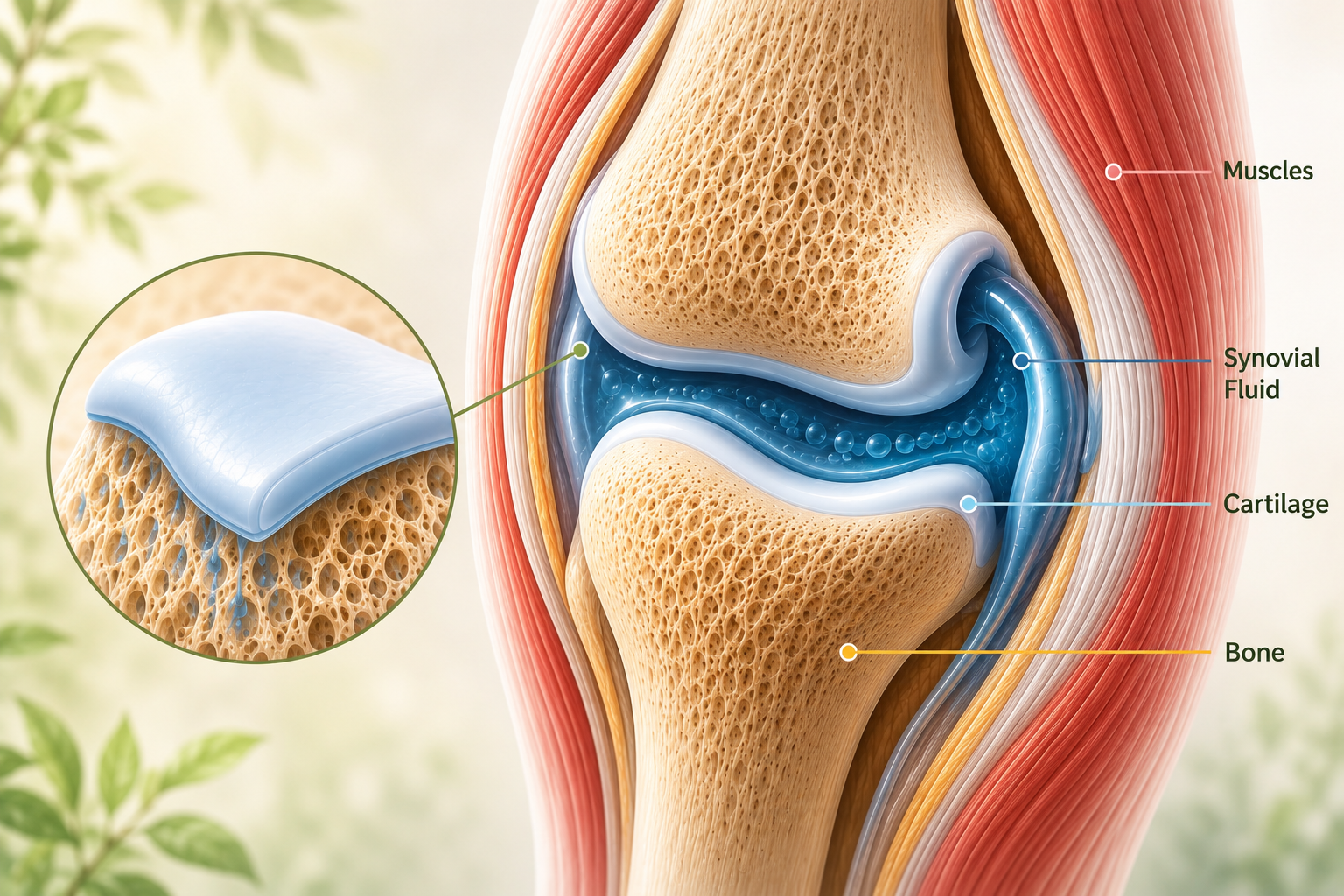
Why movement nourishes your joints — and it’s not just about exercise
🪷 Dear ones…
Today I’d like us to come back to a topic I speak about very often during consultations.
We hear this all the time:
“It’s age… what can you do… joints wear out…”
But in reality, it’s a little more complex.
Our joint cartilage is an extraordinary tissue.
It has almost no direct blood supply of its own.
That means it receives nourishment differently from most organs in the body.
The main route for delivering water, nutrients and building materials is through synovial fluid — the fluid inside our joints.
And this is where it becomes fascinating.
🦴 Cartilage is nourished… when we move.
When muscles work, the joint gently acts like a pump, moving synovial fluid through the tissues.
Exchange happens. Nutrients arrive.
Metabolic waste leaves. Movement is not stress for cartilage. For cartilage, movement is life.
But long periods of inactivity create a completely different environment.
🧠 In recent years, research has increasingly shown an interesting pattern:
during prolonged inactivity, cellular activity changes, tissue nourishment worsens, and inflammatory signalling molecules — cytokines (such as IL-6 and TNF-α) may become more active.
These processes are associated with chronic low-grade inflammation and may contribute to accelerated cartilage breakdown over time.
This does not mean sitting for one hour damages your joints.
But years of a sedentary lifestyle can become one of the factors contributing to faster wear of the musculoskeletal system.
That is why I keep repeating:
Age does not always limit movement.
Very often, lack of movement accelerates the feeling of ageing.
WHAT YOU CAN START DOING TODAY
🔸 If you have a sedentary job — stand up every 20–30 minutes, even for 1–2 minutes
🔸 Do a few squats
🔸 Walk around
🔸 Stretch
🔸 Activate your muscles
Sometimes this alone can improve tissue nourishment.
🪷 SOME OF MY FAVOURITE WAYS TO SUPPORT JOINT HEALTH
🌿 Turmeric. I’ve spoken about this before.
Using turmeric as a spice in daily meals is a wonderful habit.
But when we talk specifically about supporting joints, people often look beyond plain turmeric powder and consider forms containing curcumin combined with piperine (black pepper extract).
Why?
Because curcumin on its own is absorbed rather poorly.
The combination with piperine is widely known for helping improve bioavailability and supporting better absorption.
Today there are also newer delivery systems available (including phytosomal and other enhanced forms), but curcumin + piperine remains one of the most widely recognised combinations.
⚠️ Please remember: this approach is not suitable for everyone — especially in some gallbladder conditions, bleeding tendencies, use of anticoagulants, and individual situations.
💧 Proper hydration
And again, an important reminder.
It’s not only about how much water you drink.
It’s also about the quality of hydration.
A very rough guide is around 30 mL per kg body weight, but this is not a universal rule.
Pay attention to your body:
One simple everyday marker — urine is often light straw coloured when hydration is balanced.
Drinking excessively is not always beneficial.
When fluid and mineral balance becomes disturbed, some people notice:
⚡ heaviness in the head
⚡ weakness
⚡ dizziness
⚡ mental fog
⚡ headaches
⚡ and for those prone to migraines — possible triggers
Sometimes it’s not just water that matters, but also maintaining electrolyte balance wisely.
🦴 Type II Collagen
This is one of the components commonly discussed in joint support.
But remember: Collagen is not a brick that automatically rebuilds tissue.
It needs the right environment:
✔️ movement
✔️ enough protein
✔️ vitamin ✔️ minerals
✔️ proper nutrition
🍲 And yes — I still love good-quality bone broths as part of a balanced diet.
Choose good-quality ingredients whenever possible.
🪷 WHAT IF CHANGES HAVE ALREADY STARTED?
This is where my approach becomes comprehensive.
Depending on the individual situation, additional supportive methods may be considered:
🩸 PRP therapy (Platelet-Rich Plasma) — using the body’s own growth factors to support regenerative processes.
🪷 Hirudotherapy — used as a supportive method for local microcirculation and tissue support.
🌿 Herbal medicine — individually selected anti-inflammatory and supportive plants.
💎 Homeopathic approach — looking not only at the joint itself but at the body as a whole and its individual responses.
It is important to understand:
No method replaces movement, nutrition, and addressing the root cause.
But properly selected support may help create more favourable conditions for recovery.
And a few things that are often forgotten:
☀️ vitamin D — where appropriate
🥚 adequate protein intake
🏋️ appropriate strength activity
😴 quality sleep — because recovery happens not only in movement but also during rest
🪷 Take care of your musculoskeletal system wisely.
Don’t wait until your joints ask for help.
Give them movement today — so they can give you freedom tomorrow.
❤️ If you’d like to explore this more deeply and receive an individual approach — you’re welcome to book a consultation